When you hear “steel pallet?”, many people imagine just a welded frame from a corner, rough and heavy. This is perhaps the main misconception. In fact, this is a complex assembly, from the geometry and thickness of the metal to the type of weld that determines whether it will withstand five years of daily loader operation or collapse after the first season. I myself have long believed that the main thing is the workload for the passport, and the rest is marketing. Until I encountered a situation where a batch of pallets purchased at an attractive price began to “play?” — bend under a static load, which, according to the documents, should have been easy to hold. It turned out that the whole point is in the stiffeners, or rather, in their absence at critical points. Since then I began to look at them differently.
It all starts with design. You can take a standard drawing, but for specific tasks - for example, for storing long metal structures at the same Jusheng plant. - adaptation is needed. I saw how they work: the request comes not just “pallets for 2 tons?”, but with reference to the dimensions of beams for racking systems. And here the engineer looks at the weight distribution, at the points of contact with the forks of the loader, and decides whether to make a solid sheet flooring or a grid to prevent dirt and moisture from accumulating.
The key point is the choice of steel. Not just “ferrous metal”, but a specific brand, its yield strength. For standard tasks, cold-rolled steel is used, but for work in open areas or in aggressive environments, galvanizing or even powder coating on the ground is already required. I remember one of our clients from food production required galvanizedsteel palletswith a special type of welding so that there are no hard-to-reach places for washing. We had to reconsider the entire structure so that the seams were as smooth and accessible as possible.
Manufacturing is more than just welding. This is cutting with millimeter precision, bending, which forms those very stiffening ribs. In large industries, such as the aforementioned Harbin shelving plant “Jusheng”, this process is as automated as possible. This is not for beauty, but for repeatability of quality. When you make a batch of 500 pieces, each piece must be identical, otherwise there will be problems with docking on automated loading lines. Manual welding on such volumes is a ticket to the risk zone for deformations.
In theory, a load of 2000 kg is 2000 kg. In practice, a forklift rarely lowers a load perfectly level. Often this is a blow, often the load is shifted to the edge. And here it is not the rated load that comes to the fore, but the safety factor and, again, the design. The most significant case from my practice was related to the storage of components for shelving. The pallets were standard pallets, but they were not supported by boxes, but by heavy but compact steel brackets. The point load turned out to be critical, and the decking buckled in several places.
After that, we switched to pallets with continuous reinforced decking and additional crossbars at the bottom. It would seem that there was an overconsumption of metal, the weight has increased. But the service life has increased significantly. This is a typical situation: a cheap option at the procurement stage results in constant repairs and replacements. This is especially visible in logistics hubs, where equipment works in three shifts. There, the difference between a good and a bad pallet is visible after six months.
Another nuance is compatibility.Steel palletshould fit perfectly into a shelving unit or truck bed. A discrepancy of a couple of centimeters can paralyze the entire process chain. We somehow received a batch of pallets from a new supplier - everything seemed to be in accordance with GOST. But it turned out that the height from the bottom plane to the first structural element (the so-called fork clearance) was 10 mm less. All the forklifts with larger forks simply couldn't pick them up. I had to urgently look for someone who would remake them.
Different industries have different requirements. In the same mechanical engineering or in the production of metal structures, like “Jusheng”, often what is needed is not standard pallets, but so-called “cradles”. or heavy platforms for large and long products. Here we are already talking about channel beams, the possibility of securing the load with slings or chains directly to the body of the pallet. This is almost an individual product.
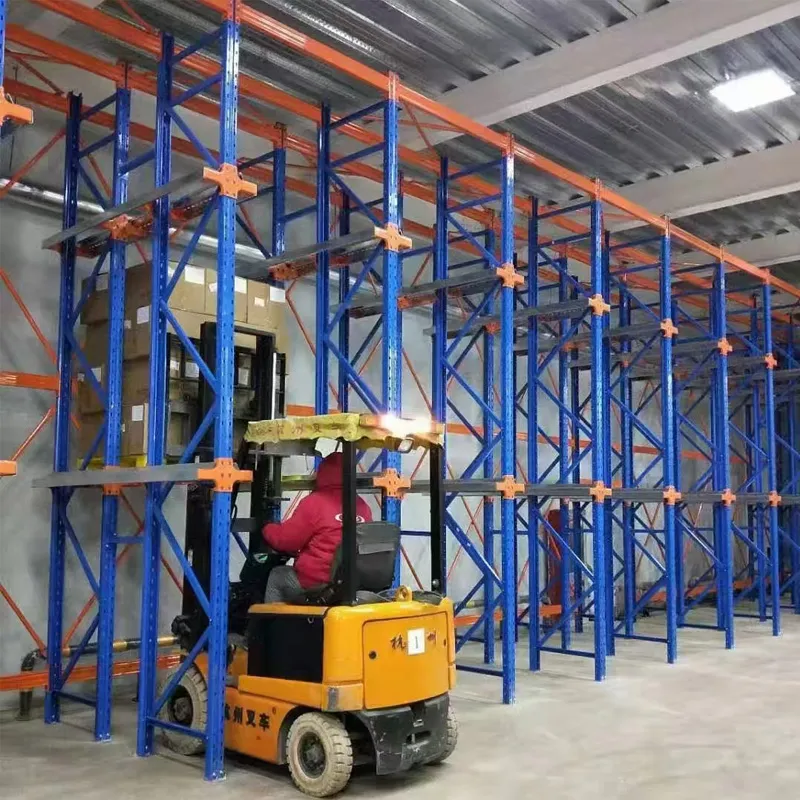
For warehouse systems, especially high-rise racks, not only strength is important, but also geometry. The pallet should lie flat on the rack beam, without distortion. The slightest ?propeller? (when the pallet is twisted diagonally) creates a monstrous load on one point, which is dangerous. Therefore, in serious production, where control is important, pallets after production are often checked on special stands that simulate the load in the rack.
A separate story - these are lightweightsteel palletsfor automated warehouses, where robotic stackers move them at great speed. The requirements for dimensional accuracy and the absence of burrs and sharp edges are prohibitive here. And weight is critical - every extra kilogram reduces the energy efficiency of the entire system. This is aerobatics in the production of such products.
Here everything depends on the competence of the plant. You can buy it from a craft workshop, but there are no guarantees. A large specialized enterprise such as ?Harbin Jusheng Metal Structure Manufacturing LLC? (https://www.jshj.ru), which deals with the full cycle from design to maintenance of racking systems, usually has a different approach. They initially look at the pallet as part of a logistics or warehouse system, rather than as a separate product. This is an important ideological difference.
What to check? Firstly, technological capabilities. Is there a bending shop, what kind of welding equipment (automatic lines or all argon arc welding), how is painting or galvanizing organized? Secondly, look at real facilities where their products have been working for more than a year. Best of all - in an open warehouse, in harsh conditions. If after a year the paint has not peeled off and there are no traces of corrosion in the welds, this is a good sign.
And of course, dialogue with technologists. When you ask a question not about the price per piece, but about how they calculate the dynamic load during a side impact with a fork, or about the type of electrode used for welding galvanized steel, it immediately becomes clear who you are dealing with. If in response you receive a clear explanation, and not a reference to a certificate, this is the same “professional in the handicraft industry”.
So, back to the beginning.Steel pallet- this is far from primitive. This is calculation, metal, quality control. This is what the efficiency of a warehouse or supply chain rests on (literally). Saving on it is like saving on the foundation. Problems will not appear immediately, but fixing them will be much more expensive. Now, looking at any pallet, I automatically evaluate the quality of the welds, look for stiffeners and estimate how it will behave under uneven load. This is probably a professional deformation. But it is precisely this that allows you to avoid mistakes that once had to be sorted out with great losses.
And yes, if the task is not just to buy hardware, but to integrate it into a complex process, then you should turn to those who think systemically. Like the same specialists from the Jusheng plant, who initially design both the racks and the pallets for them as a single whole. This has its own special reliability. Because when all the elements are created for each other, the system works like a clock. And in logistics and warehousing, this is exactly what you need - predictability and the absence of surprises.